Worried about what ocean acidification is doing to the sea? It’s a chemical shift that happens as the ocean absorbs carbon dioxide, making seawater more acidic and harder on shell-building life.
Ocean acidification is one chapter in the wider story of climate change, and this guide covers the ocean chemistry behind it.
| Item | Value |
|---|---|
| Fall in surface ocean pH since the industrial revolution began | 0.1 pH units |
| Rise in acidity that this pH change represents | approximately 30 percent |
| Share of released carbon dioxide the ocean absorbs | about 30% |
| Global average rise in ocean acidity over the past 250 years | about 26% more acidic |
These figures come from NOAA’s ocean acidification resource collection and the NOAA Ocean Acidification Program. They are estimates that can change as new measurements arrive, so check the sources before you rely on them.
What is ocean acidification?
Ocean acidification is a change in seawater chemistry that occurs when the ocean absorbs carbon dioxide, according to the NOAA Ocean Acidification Program. NOAA Fisheries says the process is fundamentally changing the chemistry of the world’s oceans and threatening our marine resources.
The extra carbon comes largely from people. The NOAA resource collection notes that in the 200-plus years since the industrial revolution began, atmospheric carbon dioxide has increased due to human actions.
NCEI, NOAA’s data centre, adds that burning fossil fuels, making cement and clearing forests have pumped about two trillion tons of carbon dioxide into the atmosphere since the Industrial Revolution began, as described in an NCEI news item.
The chemistry, step by step
- Rising carbon dioxide in the air drives matching increases of dissolved carbon dioxide in surface waters.
- The dissolved gas reacts with seawater to form carbonic acid.
- Carbonic acid breaks apart into bicarbonate ions and hydrogen ions, and the hydrogen ions make the water more acidic. This is what pH measures.
- Free hydrogen ions also react with carbonate ions to form bicarbonate, so carbonate ions become relatively less abundant.
That sequence follows NOAA’s description of seawater chemistry. The last step matters because carbonate ions are what shellfish draw on: NCEI explains that more acidic water decreases the building blocks used by shellfish to grow their shells.
How much has the ocean changed?
Since the industrial revolution began, the pH of surface ocean waters has fallen by 0.1 pH units, according to NOAA’s education collection. That sounds small, but the pH scale is logarithmic, and NOAA puts the change at approximately a 30 percent increase in acidity.
The Ocean Acidification Program gives a slightly different figure: over the past 250 years the ocean has become about 26% more acidic on average globally. Read both as approximate rather than exact, since they come from different pages and periods.
The ocean also acts as a carbon sink. NOAA says it absorbs about 30% of the carbon dioxide released in the atmosphere (NOAA), while NCEI counts about 25 percent of the excess gas, equal to over 600 billion tons of carbon dioxide, from 1750 to 2015.
Which marine life and communities are affected
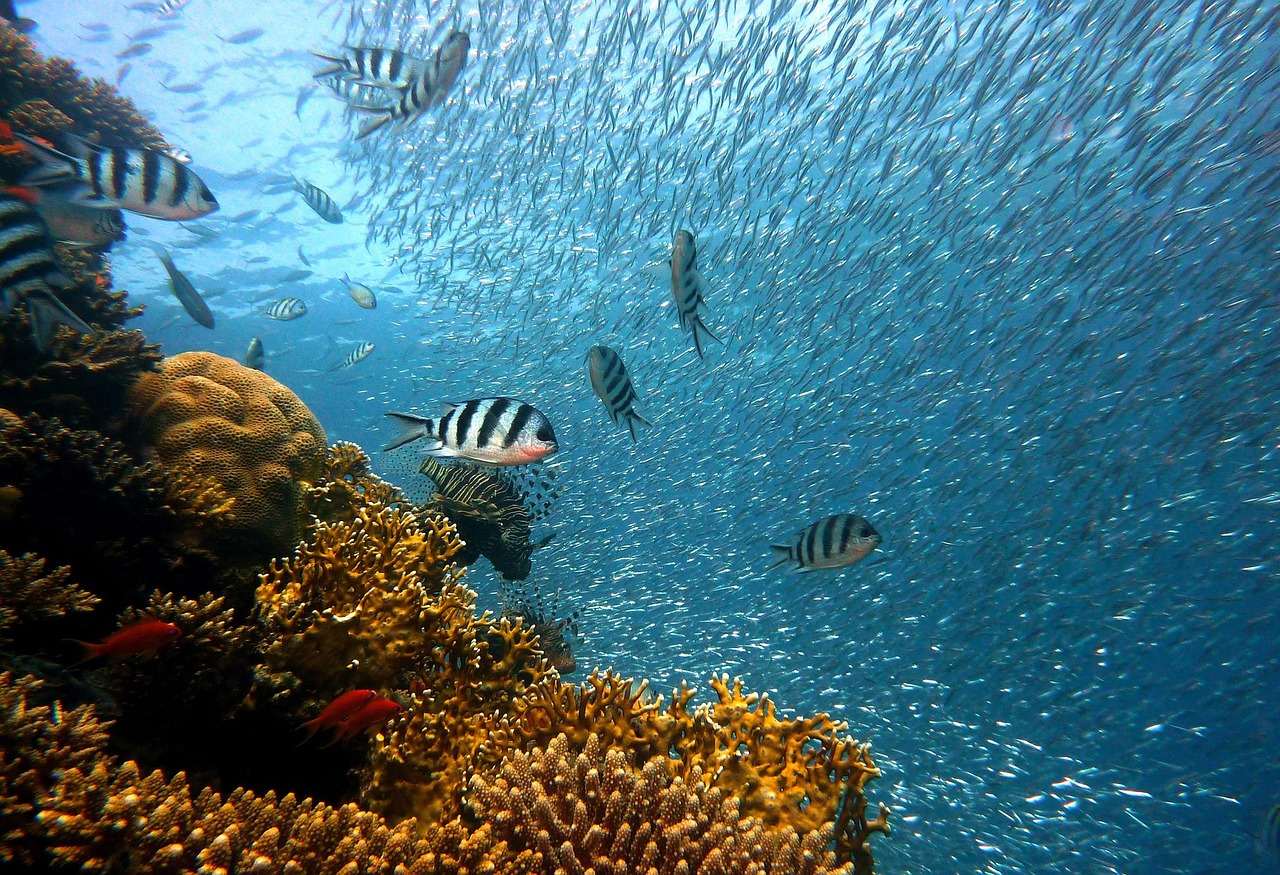
Some studies have shown negative implications for shell-building marine life, which could have difficulty building or maintaining shells in increasingly acidic waters, according to NCEI. The groups it names are:
- Clams and mussels
- Coral reefs
- Small sea snails
People are part of the picture too. The NOAA Ocean Acidification Program says the change can impact some marine life and the people who depend on them. The outcome depends on the timing, duration and severity of acidification, and on how ecosystems respond.
Coastal and freshwater acidification
Not all acidification comes straight from the air. Coastal acidification occurs from local processes that affect water chemistry, and the NOAA Ocean Acidification Program lists several drivers:
- Coastal upwelling, a natural process that brings deeper, more acidic waters to the surface ocean in the coastal zone.
- Nutrient run-off from land, which can fuel algal blooms. When the blooms die, they consume oxygen and release carbon dioxide, increasing acidity.
- Changes in wind, temperature or salinity, which can have both natural and human causes.
Lakes are affected as well. In the Great Lakes, a rise in sulfuric and nitric acid deposition from the early 20th century in the Midwestern and Northeastern United States was reversed by air-quality regulations, and the lakes are still recovering, per the same NOAA program page. Lake Superior has the most acidified waters and Lake Michigan the least.
The good news is practical: minimizing other local stresses can help ecosystems and people manage coastal acidification better, according to NOAA.
How scientists track it and what comes next
NOAA tracks ocean chemistry with four measurements, and researchers need to measure only two of them to calculate the others, as the Ocean Acidification Program explains. They are:
- pH, a measure of how many free hydrogen ions are in the seawater.
- Partial pressure of carbon dioxide, which shows how much carbon dioxide is in the water.
- Total alkalinity, the concentration of buffering molecules such as carbonate and bicarbonate that can neutralize acid.
- Dissolved inorganic carbon, which shows how much non-biological carbon is in the water.
A weakening buffer
As of NCEI’s December 18, 2019 summary of a NOAA-led study, the ocean’s buffer capacity could decrease by as much as 34 percent from 2000 to 2100 under the highest-emissions scenario. The research was published in Nature Scientific Reports, and NCEI’s page marks itself as archived content that is no longer being updated, so treat it as a dated snapshot.
The study’s reading is that the ocean will likely keep taking up more carbon dioxide, but the proportion of human-caused carbon entering it will decrease. Its role in buffering global climate change would gradually diminish, and acidification could accelerate.
Ocean chemistry is only one part of a larger system, and our explainer on climate tipping points looks at thresholds elsewhere in it. Because acidity follows carbon dioxide, the emissions pathways in our guide to the paris agreement 1.5 degrees goal bear directly on how far ocean chemistry shifts.
Frequently asked questions
Is seawater actually turning acidic?
Show answer
Not quite. The NOAA Ocean Acidification Program points out that the ocean itself is not acidic, but dissolved carbon dioxide raises its acidity, which means pH moves lower than it used to be.
Does the ocean absorbing carbon dioxide help the climate?
Show answer
Yes, in part. NCEI says the ocean has played an important role in slowing global climate change by removing carbon dioxide from the air, though the same uptake is what alters seawater chemistry.
Does acidification only affect the open ocean?
Show answer
No. Freshwater bodies like the Great Lakes also experience it, and researchers project that their pH will decline at a rate similar to that of the oceans as atmospheric carbon dioxide rises, based on the NOAA program’s overview.